
Tracking the 2026 occupancy shift
The 2026 Airbnb market data reveals a distinct split in how investors are measuring success. While average daily rates (ADR) have stabilized or dipped slightly in many mature markets, occupancy rates have become the primary driver of return on investment. This divergence marks a departure from the pandemic-era boom, where high nightly prices alone could mask low volume.
In today’s environment, a property with a moderate ADR but consistent 70%+ occupancy often outperforms a high-rate listing that sits empty for weeks. Investors are shifting focus from maximizing price per night to maximizing revenue per available room (RevPAR). This metric combines both ADR and occupancy, providing a clearer picture of actual cash flow. A common heuristic for identifying viable assets in this tighter market is the 75-55 rule, which suggests a property should hit 75% occupancy at 55% of the market’s average rate.
Understanding this shift requires looking beyond headline occupancy numbers. Seasonality is flattening in some regions, while others are seeing sharper peaks. The key is identifying markets where demand is resilient enough to sustain occupancy even when rates are adjusted downward. This resilience is what separates profitable 2026 listings from those that struggle to cover operating costs.
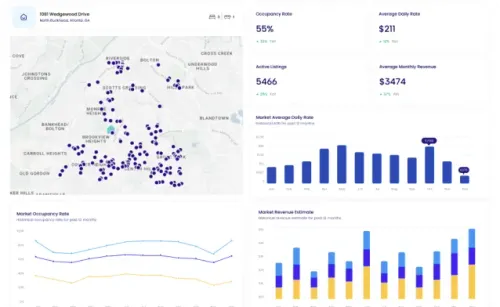
The chart above tracks Airbnb’s market performance, reflecting broader industry trends where investor sentiment is increasingly tied to operational efficiency rather than speculative growth. As the platform matures, the data suggests that sustainable ROI will belong to those who prioritize consistent bookings over sporadic high-rate spikes.
Comparing top analytics platforms
Finding the right airbnb market data source means matching the tool to your specific workflow. Whether you need deep historical trends for due diligence or real-time pricing signals for daily management, the leading platforms offer distinct advantages. We compared AirDNA, Rabbu, AirROI, and Airbtics across key metrics to help you choose the right fit for your investment strategy.
| Platform | Data Scope | Pricing Model | Best For |
|---|---|---|---|
| AirDNA | 10M+ properties, 120K markets | Freemium; paid plans start ~$99/mo | Deep market research & portfolio tracking |
| Rabbu | U.S. market focus with real-time metrics | Free core tools; premium features available | Quick U.S. market checks & beginners |
| AirROI | 20M+ properties globally | Free analytics; API access varies | Developers & API-driven automation |
| Airbtics | Worldwide with 3-year daily history | Freemium; paid plans for advanced data | Historical trend analysis & dynamic pricing |
AirDNA remains the industry standard for broad market coverage, tracking over 10 million rentals across 120,000 markets. Its depth makes it ideal for investors evaluating entire neighborhoods, though the cost can add up for those managing multiple properties. Rabbu offers a compelling free tier for U.S.-focused analysis, providing real-time occupancy and revenue projections without an upfront subscription. For those needing raw data access, AirROI tracks 20 million properties globally and provides an API, making it a favorite for developers building custom dashboards. Airbtics stands out for its three-year daily historical dataset, which is particularly useful for stress-testing revenue models against seasonal fluctuations.
When evaluating these tools, look beyond the headline price. Consider whether you need granular, property-level estimates or broad market averages. AirDNA and Airbtics provide the historical context necessary for long-term ROI projections, while Rabbu and AirROI offer faster, more accessible entry points for initial market screening. Choose the platform that aligns with your primary decision-making process, whether that is deep due diligence or rapid opportunity scanning.
Applying the 75-55 rule to 2026 data
Airbnb market data works best as a clear sequence: define the constraint, compare the realistic options, test the tradeoff, and choose the path with the fewest hidden costs. That order keeps the advice usable instead of decorative. After each step, pause long enough to check whether the recommendation still fits the reader's actual situation. If it depends on perfect timing, unusual access, or a best-case budget, include a simpler fallback.
The simplest way to apply this framework is to write down the real constraint first, compare each option against it, and choose the path that still works outside ideal conditions. For example, if your constraint is a fixed monthly mortgage payment, calculate the minimum occupancy needed to cover it using current local ADRs, rather than relying on generic industry averages.
Calculating true short-term rental ROI
Static estimates rarely survive contact with actual market data. When you calculate ROI for an Airbnb property, you are not just dividing net income by purchase price; you are modeling a dynamic system where nightly rates and occupancy fluctuate based on seasonality, local events, and platform algorithm changes. To get a realistic projection, you must ground your assumptions in live, verified data rather than generic industry averages.
Start by defining your baseline using the 75-55 rule, an informal benchmark that suggests a viable STR should achieve at least 75% occupancy at a rate no less than 55% of the market average nightly rate. This rule helps you quickly screen for properties with sufficient demand before diving into complex financial modeling. However, treat this as a starting filter, not a guarantee of performance.
To refine your model, integrate live pricing tools. Static spreadsheets cannot account for real-time supply and demand shifts. Use platforms like AirDNA or Inside Airbnb to pull granular data on your specific zip code. These sources track millions of listings, allowing you to see how actual revenue performs in your target neighborhood over the last 12 months. This historical context is essential for projecting future cash flow with any degree of confidence.
Finally, factor in the hidden costs that often erode ROI: cleaning fees, property management commissions, maintenance reserves, and platform service fees. A common mistake is to calculate gross revenue minus mortgage payments. The true ROI emerges only when you subtract all operating expenses from net operating income (NOI), then divide by your total cash investment. This gives you the cash-on-cash return, the metric that actually matters for investor decision-making.
Frequently asked questions about STR data
Investors often rely on rule-of-thumb metrics to quickly screen properties before diving into deep Airbnb market data analysis. These heuristics help filter out underperforming assets, though they should always be validated against local supply and demand trends.
Is the 75-55 rule still relevant in 2026?
While useful for quick screening, the 75-55 rule is becoming less reliable as market saturation increases. Investors should use it as a starting point but rely on granular Airbnb market data from platforms like AirDNA to validate actual performance in specific neighborhoods.
How do I find reliable Airbnb market data?
Use dedicated analytics platforms like AirDNA, which tracks over 10 million rentals across 120,000 markets. These tools provide accurate occupancy rates, average daily rates, and seasonality trends that are essential for accurate ROI calculations.
Can I set an age restriction lower than 25?
Yes, hosts can set age minimums lower than 25, but Airbnb allows hosts to set the limit anywhere up to 25. Any age restriction must be applied consistently to all guests and clearly stated in the listing details to avoid disputes.
No comments yet. Be the first to share your thoughts!