

Why an Airbnb revenue calculator matters
Estimating short-term rental income by hand is a gamble. Relying on rough guesses or static averages often leads to overestimating occupancy or underestimating seasonal fluctuations. Without precise data, you are essentially making high-stakes financial decisions in the dark. A dedicated Airbnb revenue calculator removes the guesswork by pulling real-time comparable data, giving you a realistic picture of potential earnings before you commit capital.
Manual math might look simple on paper: multiply your average daily rate by estimated nights booked. However, this approach ignores critical variables like local regulations, competitor saturation, and dynamic pricing trends. Data-backed tools account for these nuances, providing a granular view of projected revenue, average daily rate (ADR), and occupancy percentages based on actual market performance in your specific neighborhood.
The difference between a rough estimate and a professional projection can mean the difference between a profitable investment and a money pit. Industry data suggests that while typical STR ROI ranges from 8% to 12%, top performers leveraging accurate forecasting often exceed 15%. By using a robust calculator, you align your expectations with market reality, ensuring your financial model holds up under scrutiny.
How the best calculators estimate revenue
An Airbnb revenue calculator turns raw market data into a projection you can actually plan around. The tools don’t guess; they run a straightforward multiplication of your property’s expected daily income against how many nights it will likely be booked. Understanding the three inputs that drive these numbers—Average Daily Rate (ADR), occupancy, and seasonal adjustments—helps you see past the final dollar figure and evaluate the health of the underlying assumptions.
Average Daily Rate (ADR)
ADR is the average price you charge per night. In a revenue calculator, this isn’t just your current listing price; it’s a benchmark derived from comparable properties in your area. Tools like AirROI and Rabbu pull from millions of listings to show you what similar homes in your zip code are actually earning. If you set your ADR too high, the calculator will show a drop in bookings. If you set it too low, you leave money on the table. The goal is to find the sweet spot where price and volume balance out.
Occupancy represents the percentage of nights your property is booked over a specific period. This is where the calculator’s data quality matters most. A high ADR means little if the calendar sits empty. Most robust calculators use historical booking trends and local event calendars to estimate realistic occupancy. For example, a beach house in July might project 90% occupancy, while the same property in November might drop to 40%. These tools help you visualize those dips so you aren’t surprised by seasonal slumps.
Seasonal Adjustments
Seasonality is the hidden variable that can make or break your ROI. The best calculators don’t just give you an annual average; they break down projections month by month. This allows you to see how holiday spikes or off-peak lulls affect your bottom line. By adjusting your ADR dynamically—raising prices during peak demand and offering discounts during slow periods—you can smooth out revenue volatility. This dynamic modeling is what separates a simple multiplication tool from a true revenue estimator.
Top 6 Airbnb Revenue Calculators Compared
Finding the right airbnb revenue calculator comes down to matching your specific needs with the right data depth and interface. Some tools excel at quick, free estimates, while others offer the granular market insights required for high-stakes investment decisions. Below is a side-by-side comparison of the leading options: AirDNA, AirROI, Rabbu, BNBCalc, PriceLabs, and ListingOK.
| Tool | Data Scope | Best For | Pricing Model |
|---|---|---|---|
| AirDNA | Global (190+ countries) | Deep market research & comp analysis | Free calculator; paid reports |
| AirROI | Global (20M+ properties) | Quick, broad-market estimates | Free calculator; paid CRM |
| Rabbu | U.S. markets only | U.S.-focused ROI analysis | Free calculator; paid subscription |
| BNBCalc | U.S. markets only | Detailed financial modeling | Free calculator; paid Pro version |
| PriceLabs | Global | Dynamic pricing integration | Free calculator; paid SaaS |
| ListingOK | Global (150+ countries) | Fast, simple ROI checks | Free calculator; paid analytics |
AirDNA and AirROI dominate the global landscape, leveraging massive datasets to provide projections for markets worldwide. AirDNA is particularly strong if you need to understand competitive dynamics, while AirROI offers a broader, quicker snapshot of potential revenue across millions of properties. For investors focused strictly on the U.S., Rabbu and BNBCalc provide more localized financial modeling, including detailed expense breakdowns that are critical for accurate net operating income calculations.
PriceLabs and ListingOK round out the list with different strengths. PriceLabs is ideal if you plan to integrate your revenue estimates directly into a dynamic pricing engine, while ListingOK offers a streamlined experience for those who need a fast, no-frills ROI check across 150+ countries. Choose the tool that aligns with your geographic focus and the level of financial detail you require for your decision-making process.
Calculate net profit, not just gross revenue
Gross revenue is a vanity metric. It tells you how much money flowed through the door, but it says nothing about what you actually keep. To understand the true financial health of your rental, you need to strip away the costs. An accurate airbnb revenue calculator doesn't just estimate income; it subtracts the inevitable expenses to reveal your net profit.
Think of gross revenue as the size of the pie, but net profit is the slice you can actually eat. If you ignore the crust, the filling, and the plate, you might think you're feasting when you're barely breaking even. Subtracting these costs is the only way to see if your property is a profitable asset or a money pit.
Here is the step-by-step process to calculate your true bottom line.
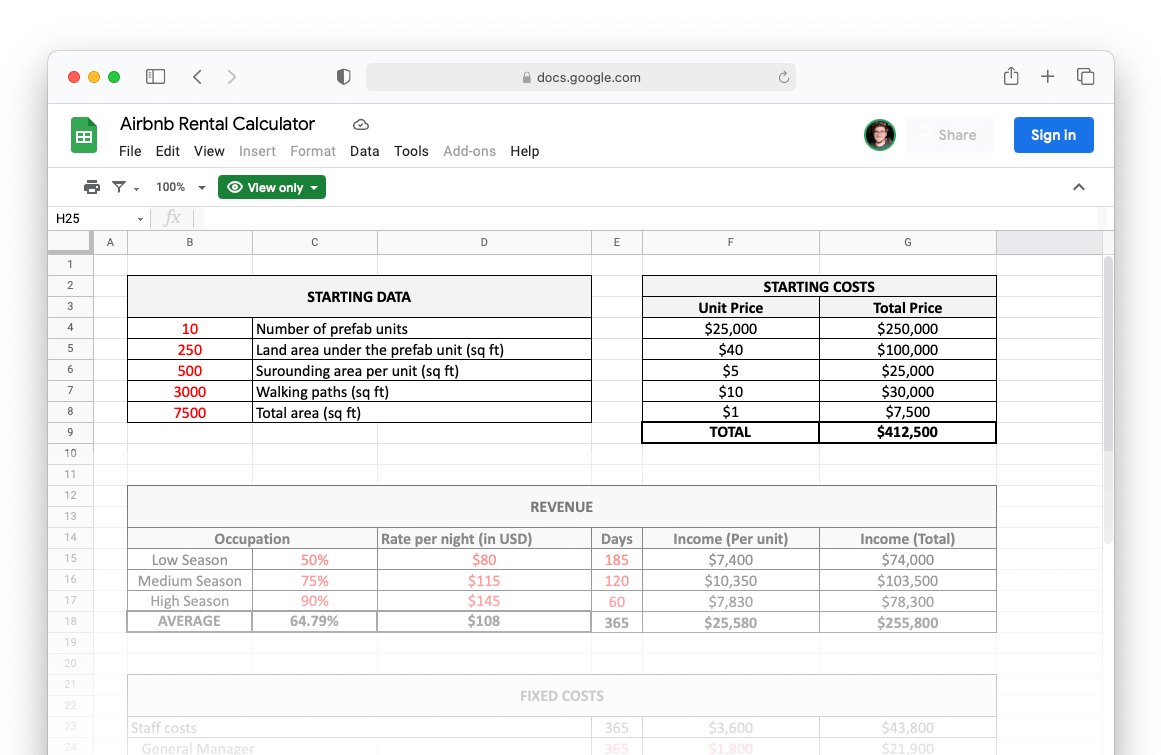
Start with your estimated annual income. Most tools calculate this by multiplying your average daily rate (ADR) by your projected occupancy rate. While this gives you a headline number, it is only the starting point for a real ROI analysis.
Airbnb and Vrbo take a cut. Hosts typically pay a service fee of around 3%, but this can rise to 14% or more depending on your cancellation policy. Additionally, you must account for local occupancy taxes and transient lodging taxes, which vary significantly by municipality. These are non-negotiable costs that come out of every booking.

Cleaning fees are often passed to guests, but you still pay the cleaner. Maintenance is the silent killer of ROI. Set aside 10-15% of your gross revenue for routine repairs, replacements, and unexpected fixes. Without this buffer, a broken water heater or a leaky roof can wipe out months of profit.
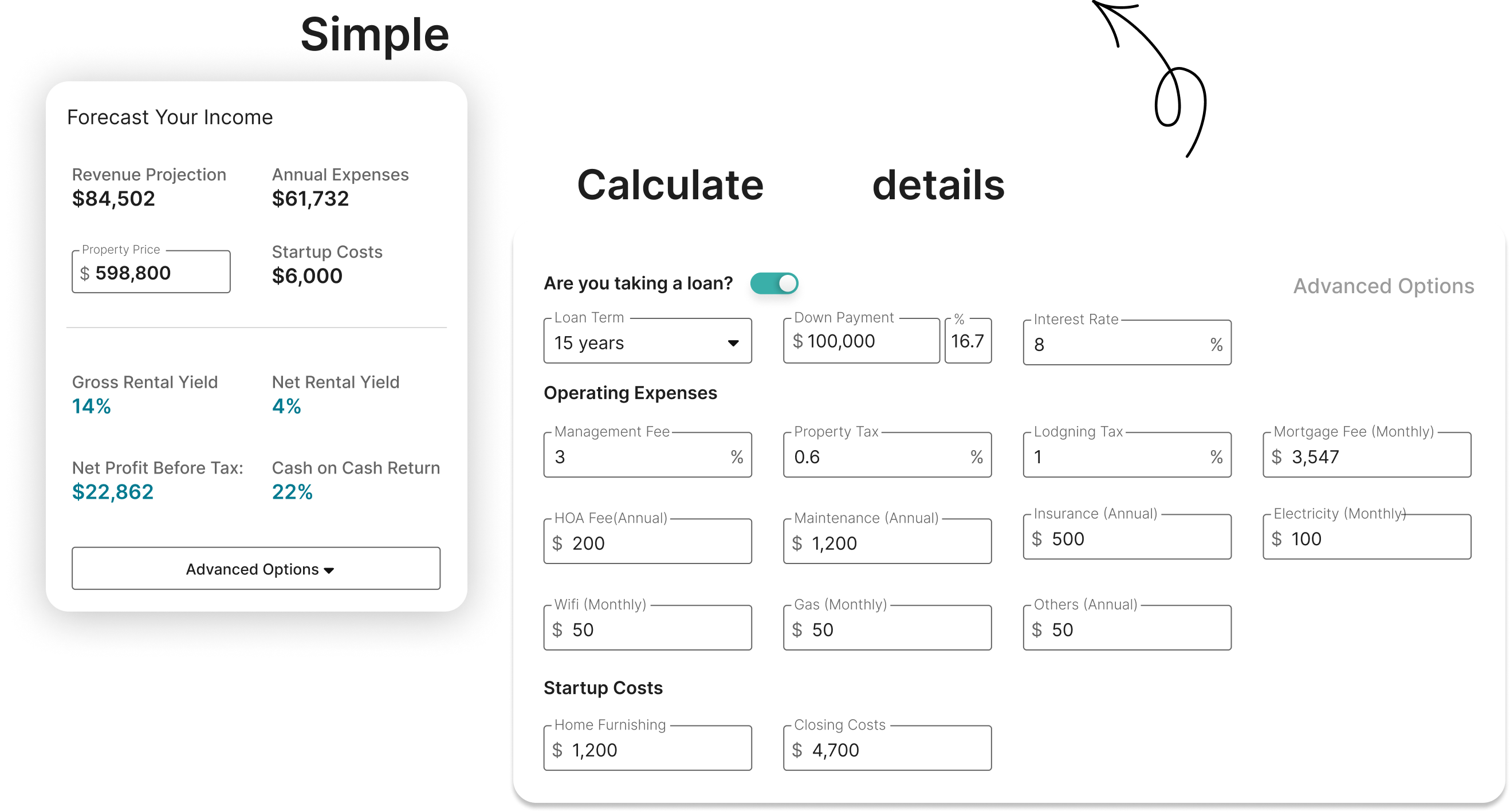
If you aren't managing the property yourself, a management company will take 20-25% of the revenue. Even if you self-manage, you need to budget for specialized short-term rental insurance, which is often more expensive than standard homeowner's policies. These fixed costs must be deducted before you can claim any profit.
Subtract all the above expenses from your gross revenue. The result is your Net Operating Income (NOI). This is the actual cash flow your property generates before debt service. A healthy STR should aim for an ROI between 8% and 12%; anything over 15% is considered excellent.
By focusing on net profit, you move from guessing to knowing. This approach ensures your airbnb revenue calculator reflects reality, helping you make high-stakes financial decisions with confidence.
Stop Overestimating Your Income
The most common reason new investors fail isn’t bad luck; it’s optimistic math. When you feed an airbnb revenue calculator its first set of data, it’s tempting to accept the top-line projection at face value. These tools often default to best-case scenarios, assuming your property will run at peak capacity year-round. In reality, even the most desirable locations experience seasonal lulls, maintenance downtime, and market saturation.
To avoid this trap, treat the calculator’s maximum occupancy as a ceiling, not a floor. A prudent strategy is to apply a conservative buffer, aiming for 70–80% of the tool’s projected occupancy during your first year. This adjustment accounts for the learning curve of managing a short-term rental and unexpected vacancies that no algorithm can fully predict.
Equally dangerous is underestimating the "soft costs" that drain your net operating income. Beyond the obvious expenses like cleaning and utilities, you must account for platform fees, property management commissions, and routine maintenance. Airbnb’s service fees can range from 3% to over 14% depending on your cancellation policy, a variable that significantly impacts your bottom line if ignored.
By grounding your projections in these realistic constraints, you shift from hoping for profit to engineering it. A reliable airbnb revenue calculator should serve as a stress-testing tool, revealing how sensitive your ROI is to changes in occupancy and expense, rather than just a marketing brochure for your future income.
No comments yet. Be the first to share your thoughts!