
Why manual estimates fail
Relying on gut feelings or simple occupancy multipliers is a common mistake that can lead to significant financial losses. When you estimate potential income by multiplying a rough occupancy rate by an assumed average daily rate, you are creating a static model for a dynamic market. This approach ignores the complex variables that actually drive short-term rental performance, such as seasonality, local regulatory caps, and neighborhood-specific demand shifts.
A true Airbnb revenue calculator moves beyond these simplistic assumptions. It integrates real short-term rental comp data to project revenue, average daily rate (ADR), and occupancy with far greater precision. By using a data-driven tool, you account for the nuances of your specific market, ensuring your return on investment (ROI) calculations are based on reality rather than optimism. This distinction is critical for high-stakes financial decisions where accuracy matters.
Choose a reliable data source
Your Airbnb revenue calculator is only as good as the data feeding it. Generic averages smooth out the rough edges of local markets, hiding the reality of seasonal dips or neighborhood-specific saturation. To get an accurate ROI, you need a tool that pulls from real, verified short-term rental (STR) comp data rather than long-term rental estimates or outdated listings.
Look for calculators that update their data weekly or in real-time. Platforms like AirDNA and Rabbu aggregate data directly from major booking sites, giving you a snapshot of what hosts are actually earning right now. This granularity allows you to see how a specific property type performs in a specific zip code, rather than relying on city-wide medians that might mislead your underwriting.
When comparing options, prioritize freshness and integration. A calculator that hasn’t updated its comps in months is essentially guessing. Below, we compare three leading tools based on their data sources, update frequency, and cost structure to help you pick the right foundation for your analysis.
| Tool | Data Source | Update Frequency | Cost |
|---|---|---|---|
| AirDNA | Real STR comps | Weekly | Free start / Paid plans |
| Rabbu | Real STR comps | Weekly | Free |
| BNBCalc | Airbnb & Vrbo | Daily | Free / Premium |
Enter property and market inputs
An Airbnb revenue calculator is only as accurate as the data you feed it. Think of the tool as a high-performance engine; if you put low-grade fuel in, you won’t get high-performance results. To get a realistic ROI projection, you need to move beyond guesswork and input precise property specs and local market trends.
Start by selecting your location. This is the single most influential variable in any revenue model. Airbnb’s own interactive tool, for instance, computes estimated income by weighing geography heavily against prior booking data in that specific area. A two-bedroom condo in downtown Austin will have a completely different revenue ceiling than the same unit in a rural suburb, even if the interior finishes are identical. Be as specific as possible with your address or neighborhood to capture local demand patterns.
Enter the exact city, neighborhood, or zip code. Local occupancy rates and seasonal demand vary wildly even within the same metropolitan area. Specificity here ensures the calculator pulls the right historical booking data for your exact market.
Input the unit type (entire home, private room, etc.), bedroom count, and square footage. These physical attributes directly dictate your nightly rate potential and your target guest demographic. Accurate specs prevent the calculator from overestimating capacity or underestimating maintenance costs.
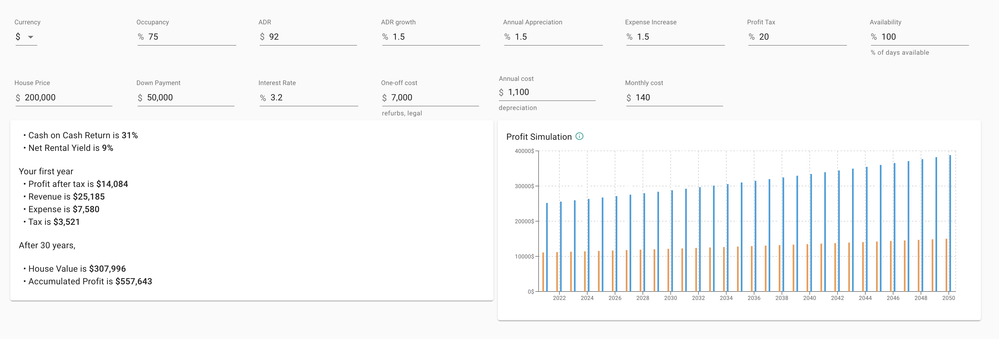
Add details like pool access, parking, or pet-friendliness, and set your expected occupancy rate. While tools like RedAwning’s estimator use data from thousands of managed properties to project yields, your personal occupancy goals should reflect your management style—whether you’re using a professional host or managing it yourself.
Once these inputs are locked in, the calculator can generate a baseline revenue estimate. Remember that these figures are projections, not guarantees. Market conditions shift, and new competitors enter the space regularly. Use these inputs to establish a realistic floor for your investment, not a ceiling for your expectations.
Adjust for operating expenses
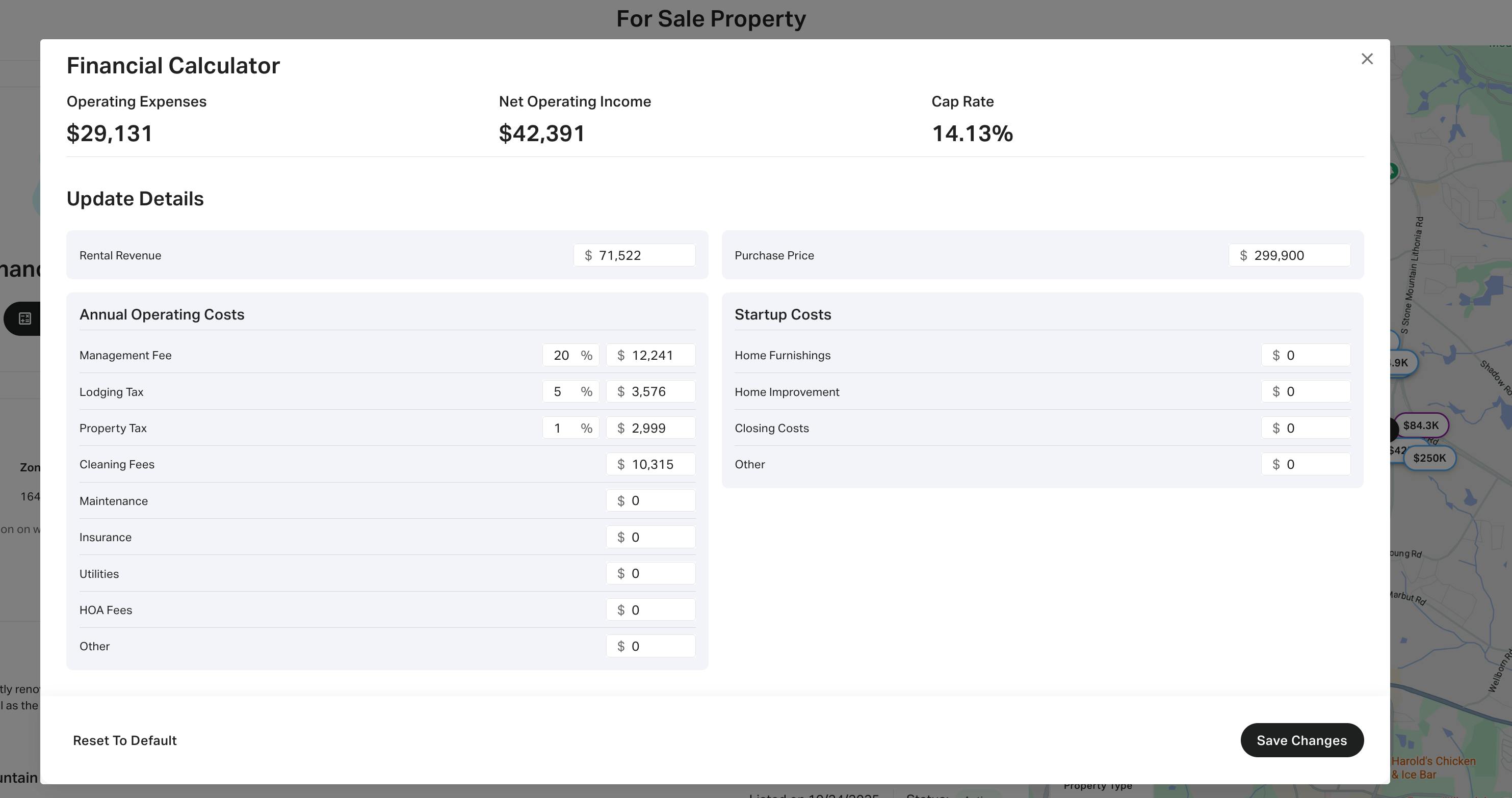
Gross revenue is just the starting line. To find your actual return, you need to subtract the real costs of running a short-term rental. Most new hosts overestimate profit because they forget that Airbnb is a service business with ongoing overhead.
Start by deducting platform fees. Airbnb charges hosts a standard 3% service fee on payouts. If you list on multiple platforms like Vrbo, those management fees can climb significantly, often eating up 14-16% of your gross income.
Next, account for recurring operational costs. Cleaning fees are usually passed to guests, but you must cover the cost of linens, supplies, and professional cleaners. Property management, if you hire a company, typically takes 20-30% of revenue. Don't forget utilities, internet, insurance, and local occupancy taxes.
Once you subtract these expenses from your gross revenue, you have your net operating income (NOI). This number is the only one that matters for accurate ROI calculations.

-
Platform service fees (usually 3%)
-
Property management fees (if applicable)
-
Cleaning and laundry costs
-
Utilities and internet
-
Insurance and property taxes
-
Maintenance and repairs reserve
Validate results against local comps
Your Airbnb revenue calculator gives you a projection, not a guarantee. To trust those numbers, you need to cross-reference them with actual comparable listings in your neighborhood. This step separates optimistic estimates from realistic expectations.
Start by identifying three to five active listings that closely match your property. Look for similar bedroom counts, amenities, and location quality. If your calculator assumes 80% occupancy, check if those comps actually achieve similar rates during your peak seasons. Tools like AirDNA allow you to enter your address and see projected revenue based on real STR comp data, giving you a benchmark to test your own assumptions against.
Pay close attention to seasonal fluctuations. A calculator might average out the year, but your local market could have sharp drops in winter. If your comps show a 20% dip in occupancy during November and December, adjust your calculator’s inputs accordingly. This sanity check ensures you aren’t overestimating income during slow periods.
Finally, compare the average daily rate (ADR) your calculator predicts with what similar listings are actually charging. If your model assumes a $200 ADR but comparable properties are booking at $150, your ROI will be significantly lower than projected. Adjusting for these real-world variances helps you make high-stakes financial decisions with confidence.
Common calculation mistakes to avoid
The easiest mistake with Use an Airbnb Revenue Calculator for Accurate ROI is comparing options on the most visible detail while ignoring the day-to-day constraint. A choice can look strong on paper and still fail because it is too hard to maintain, too expensive to repeat, or awkward in the actual setting. Use the same checklist for every option: fit, cost, durability, timing, upkeep, and fallback plan. That keeps the comparison practical instead of drifting into preference alone.
The simplest way to use this section is to write down the real constraint first, compare each option against it, and choose the path that still works outside ideal conditions.
Frequently asked: what to check next
How accurate are Airbnb revenue calculators?
Calculated projections are estimates, not guarantees. Tools like AirDNA and BNB Calc rely on historical comp data to forecast revenue, but they cannot predict future market shifts or sudden regulatory changes. Treat these numbers as a baseline for feasibility rather than a fixed promise of income.
What is a good ROI for an Airbnb?
A healthy cash-on-cash return typically sits between 8% and 12% for short-term rentals. However, this varies significantly by market. In high-demand tourist areas, lower percentages may still be acceptable due to appreciation potential, while secondary markets often require higher yields to justify the operational effort.
Do calculators include all operating expenses?
Most standard calculators account for mortgage, taxes, insurance, and cleaning fees. However, they often underestimate maintenance, utilities, and platform service fees. Always add a 10-15% buffer for unexpected costs to ensure your net operating income reflects reality.
Can I use a calculator for Vrbo or other platforms?
Yes. Many robust tools, such as BNB Calc, allow you to compare revenue across Airbnb, Vrbo, and Booking.com. This helps you determine which platform offers the best occupancy rates and average daily rates for your specific property type.
No comments yet. Be the first to share your thoughts!