
Why manual estimates fail
Guessing your Airbnb revenue is like planning a cross-country road trip with only a map and a prayer. You might have a general idea of the distance, but you have no way of knowing the exact fuel costs, tolls, or detours. In short-term rental investing, that kind of guesswork is expensive. Manual estimates often rely on broad market averages or optimistic occupancy rates that simply don't exist in reality.
When you try to calculate ROI without a dedicated airbnb revenue calculator, you are likely missing critical local variables. A simple web search might tell you the average daily rate (ADR) for a city, but it won't account for seasonal fluctuations, local regulatory fees, or the specific performance of comparable properties in your exact neighborhood. These gaps turn your "estimate" into a liability.
Tools like AirDNA and BNB Calc exist because manual math is prone to human error and bias. Investors tend to overestimate occupancy and underestimate vacancy costs. By using a data-driven calculator, you replace optimism with verified comp data, ensuring your financial projections are grounded in the actual performance of similar properties rather than wishful thinking.
Choose a reliable data source
An Airbnb revenue calculator is only as good as the data feeding it. If the tool relies on generic averages or outdated listings, your ROI projections will be wrong. You need a calculator that pulls from real, recent short-term rental transactions to give you a clear picture of what a property can actually earn.
When selecting an airbnb revenue calculator, prioritize tools that update their market data frequently. Weekly updates are the standard for reliable market intelligence. This ensures you are seeing current demand patterns, not historical ghosts. Look for specific metrics like Average Daily Rate (ADR), occupancy rates, and Cap Rate, as these are the pillars of accurate financial modeling.
Here is how the top options compare based on data freshness, cost structure, and metric depth:
| Tool | Data Freshness | Cost | Key Metrics |
|---|---|---|---|
| AirDNA | Real comp data | Free start, paid plans | ADR, Occupancy, Revenue |
| Rabbu | Weekly updates | Free | ADR, Occupancy, Profit |
| BNBCalc | Airbnb & Vrbo | Free basic | Revenue, Cap Rate, ROI |
AirDNA is widely considered the industry leader for short-term rental data. It uses real transactional data from thousands of hosts to project revenue, ADR, and occupancy. While it offers a free tier to start, deeper insights require a subscription. This makes it ideal for investors who need high-fidelity data for serious due diligence.
Rabbu offers a free calculator with weekly-updated data for U.S. markets. It focuses on simplicity, providing quick estimates for occupancy, ADR, and profit potential. It is a strong choice for beginners or those who want a no-cost entry point to analyze a property. However, its data coverage is limited to the U.S., so it is not suitable for international investments.
BNBCalc is another popular option that pulls data from both Airbnb and Vrbo. It eliminates financial guesswork by providing instant revenue projections. The tool is free to use for basic calculations, making it accessible for new investors. It is particularly useful for comparing short-term rental revenue against long-term rental potential.
Avoid calculators that do not disclose their data sources. If a tool does not specify how often it updates its market data, it is likely using stale information. Always verify that the calculator you choose provides transparent, up-to-date data to ensure your ROI calculations are accurate.
Enter property details and comps
Getting an accurate return on investment from an Airbnb revenue calculator starts with the data you feed it. Garbage in, garbage out. If you enter vague or optimistic numbers, your projection will look like a winning deal right until you try to pay the mortgage.
The most common mistake hosts make is relying on the tool’s default "average" market data. Those broad averages dilute your specific location’s potential. To get a realistic picture, you need to manually input precise property details and, more importantly, select direct comparable listings that mirror your actual unit.
Step 1: Enter your exact address and property specs
Start by entering the full property address. This allows the calculator to pull localized market data rather than generic city-wide averages. Be precise with the property type (entire home, private room, shared room) and the number of bedrooms and bathrooms.
Include unique amenities that drive higher daily rates, such as a hot tub, dedicated workspace, or parking. These details help the algorithm adjust the expected average daily rate (ADR) to match what guests are actually willing to pay in your specific neighborhood.
Enter the full property address to anchor the calculator to local market data. Select the correct property type and count bedrooms, bathrooms, and unique amenities like parking or a hot tub to refine the base rate.
Identify 3 to 5 active listings in your immediate vicinity that closely match your unit’s size, amenities, and condition. These comps provide the real-world occupancy and revenue benchmarks the calculator uses to project your earnings.
Manually adjust the projected occupancy rate if the tool defaults to a flat annual average. Account for local seasonal dips, major holidays, or planned maintenance periods to create a more conservative and realistic revenue forecast.
Step 2: Select 3-5 direct comparable listings
This is the most critical step for accuracy. Instead of letting the calculator guess your market position, you manually select 3 to 5 "comps" (comparable listings). These should be active listings in your immediate neighborhood that match your unit’s size, amenities, and condition.
Look for properties with similar bedroom counts, recent renovations, and comparable guest ratings. If your unit has a pool, choose comps with pools. If yours is a cozy studio, don’t compare it to a luxury four-bedroom house. The closer the match, the more reliable the revenue projection.
Step 3: Adjust for seasonality and vacancy
Most calculators provide a default occupancy rate based on annual averages. This can be misleading if you are in a seasonal market. Adjust the projected occupancy rate to reflect local reality.
If you are in a beach town, expect high summer occupancy and low winter numbers. If you are in a business district, weekdays might outperform weekends. Adjusting these inputs ensures your Airbnb revenue calculator reflects actual cash flow, not just theoretical maximums.
Adjust for hidden operating costs
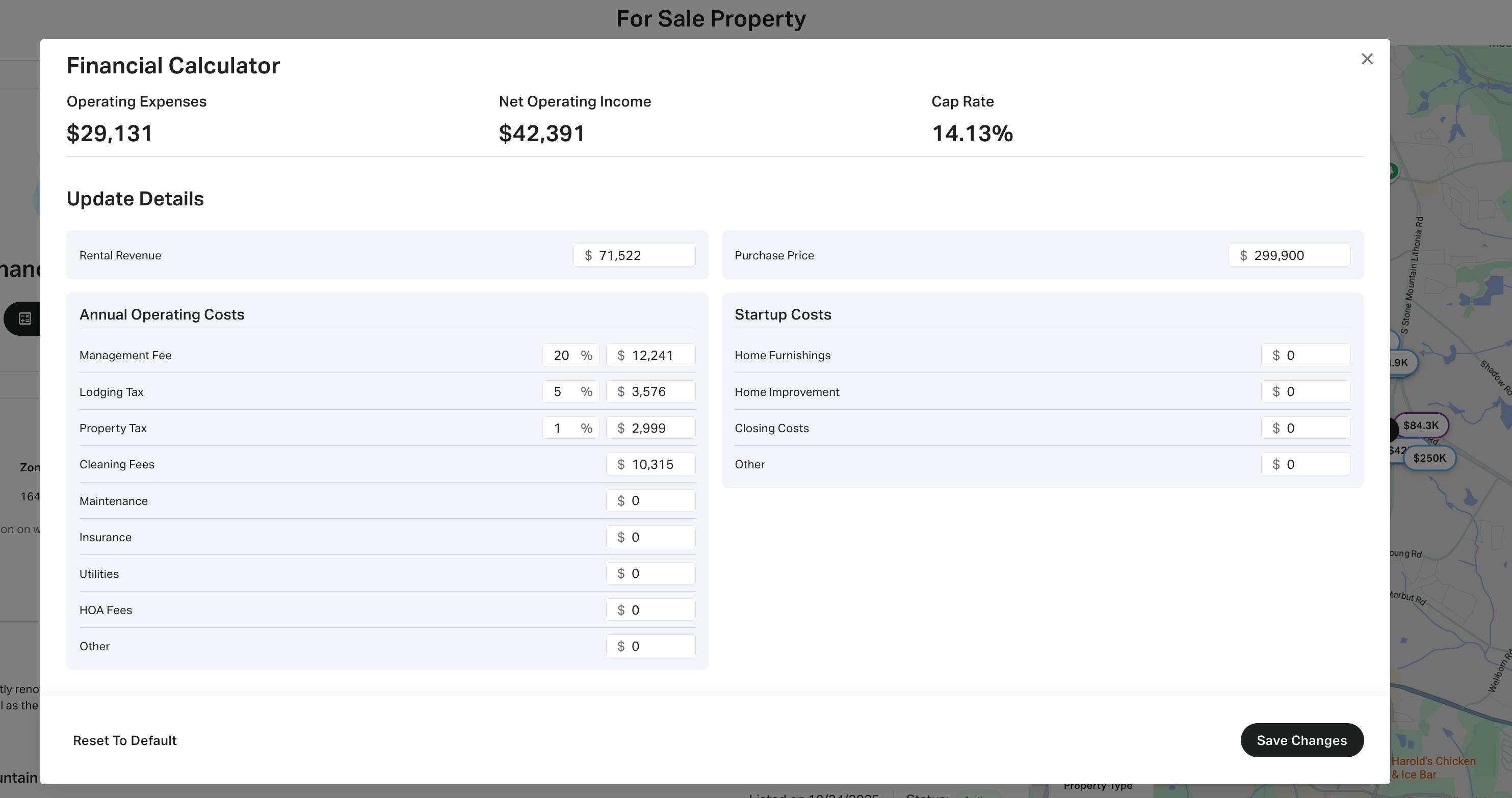
Most beginners make the mistake of looking only at the top line. Gross revenue looks impressive on a dashboard, but it doesn't pay the mortgage. To get a realistic return on investment, you need to strip away the friction costs that eat into your nightly rate. This is where using an airbnb revenue calculator correctly becomes critical; it forces you to account for the expenses that happen before you ever see a dollar in profit.
Start by subtracting the hard costs of hosting. Management fees, if you hire a co-host or property manager, typically range from 15% to 25% of gross revenue. Cleaning fees are another fixed cost per stay that you must cover out of your payout. Utilities, internet, and streaming services are often overlooked line items that add up quickly in a fully furnished unit.
Taxes and insurance form the next layer of deductions. Beyond standard homeowner insurance, you may need short-term rental endorsements. Local occupancy taxes and transient rental taxes vary by municipality and must be factored in to avoid surprise bills from the city.
Once you have subtracted these operating expenses from your gross income, you arrive at your Net Operating Income (NOI). This number is the true reflection of your property's cash flow potential. Without this adjustment, your ROI projections are likely inflated by 30% to 50%, leading to poor investment decisions.
Validate projections with local rules
Your Airbnb revenue calculator provides a financial baseline, but it cannot account for the specific zoning laws and regulatory restrictions that dictate whether you can legally operate. A high projected ROI is meaningless if your city bans short-term rentals entirely or limits hosting to primary residences only. Before you book your first guest, you must verify that your property type and location allow for the activity your calculator assumed.
Start by checking your city’s official planning or zoning department website for short-term rental ordinances. Look for specific codes regarding occupancy limits, permit requirements, and registration fees. Many municipalities require hosts to register their properties and pay transient occupancy taxes, which directly impact your net profit. Failure to comply can result in heavy fines or the immediate shutdown of your listing.
If you live in a condo or a community with a homeowners association (HOA), review your governing documents. HOAs often have stricter rules than the city, potentially prohibiting rentals under a certain duration or requiring board approval. These private restrictions are just as binding as municipal laws and can invalidate your business model regardless of what the revenue calculator suggests.
Frequently asked questions about Airbnb revenue calculators
Understanding how these tools work helps you avoid overestimating your income. Here are the most common questions about accuracy and data sources.
No comments yet. Be the first to share your thoughts!